11/23/26 Reflection on Church Street Blues
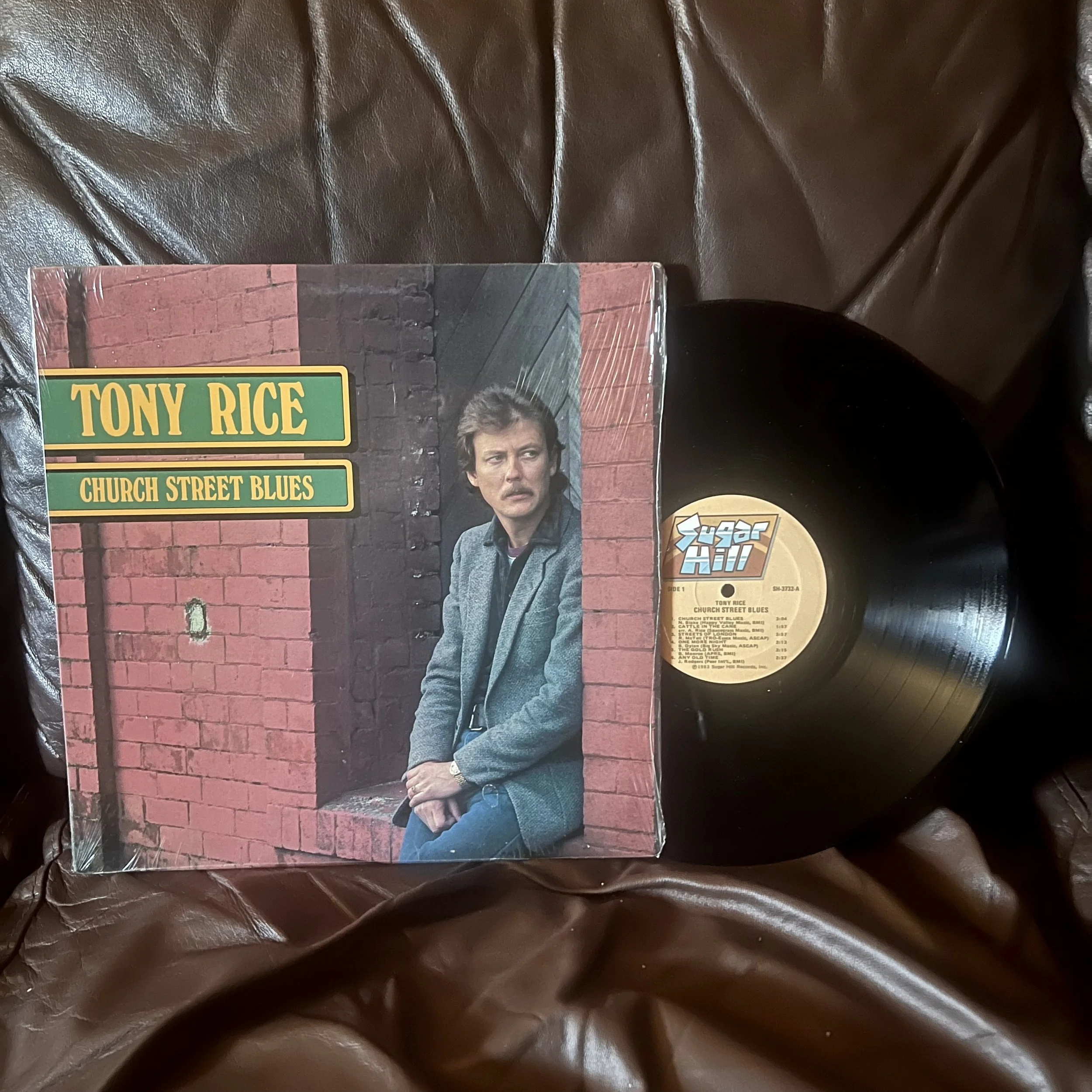
Lucked my way into a mint-condition first pressing of Tony Rice’s 1983 album Church Street Blues.
Every once in a while, an album changes your sense of what’s possible. I’d played guitar in and out of bands for over 25 years when this album found me. I was demolished by what Tony could do with just his voice, hands, metal and wood. Within a month, I quit my jam band, bought a Martin D-28, and started waking up at 4 AM to drill fiddle tunes with a metronome before work. I’d found what I wanted to do when I grew up, at 39 no less.
Tony Rice was a pioneering bluegrass flatpicker who ventured far beyond the genre. On Church Street Blues, he sings and plays mostly solo, with a guitar that seems to carry on a conversation with his voice. It feels like hot coffee by a clear lake on a crisp autumn morning in the north woods, about to go fishing. Joyful, grounded, a little mischievous. What floored me wasn’t just the virtuosity. It was how complete the music sounded with so little. Nothing was missing.
I’d already begun writing songs, but this album crystallized my medium: solo voice and acoustic guitar, drawing on the harmonic vernacular of American roots music, with bluegrass-inspired flatpicking providing color and contrast. What followed was years of writing songs, grinding through open mics, recording three EPs and an LP, and booking shows, all on my own.
Solo acoustic performance is a severe design choice. No band, no elaborate production, nowhere to hide. The songs and arrangements either work or they don’t.
But there’s freedom in that limitation. When you’re solo, you write and arrange without negotiating. Practice when you want. Book shows with an email. Soundcheck takes two minutes. You want to make a record? Book a studio and finish it in a day.
With a family and career, that practicality matters. I’ve come to believe that in a finite world, freedom is often maximized through self-chosen constraints.
I’m no Tony Rice, nor am I trying to be a bluegrass purist. I write my own songs from my own point of view. But on Church Street Blues, Tony showed me just how much was possible with nothing more than a voice, two hands, a wooden box, and six strings.